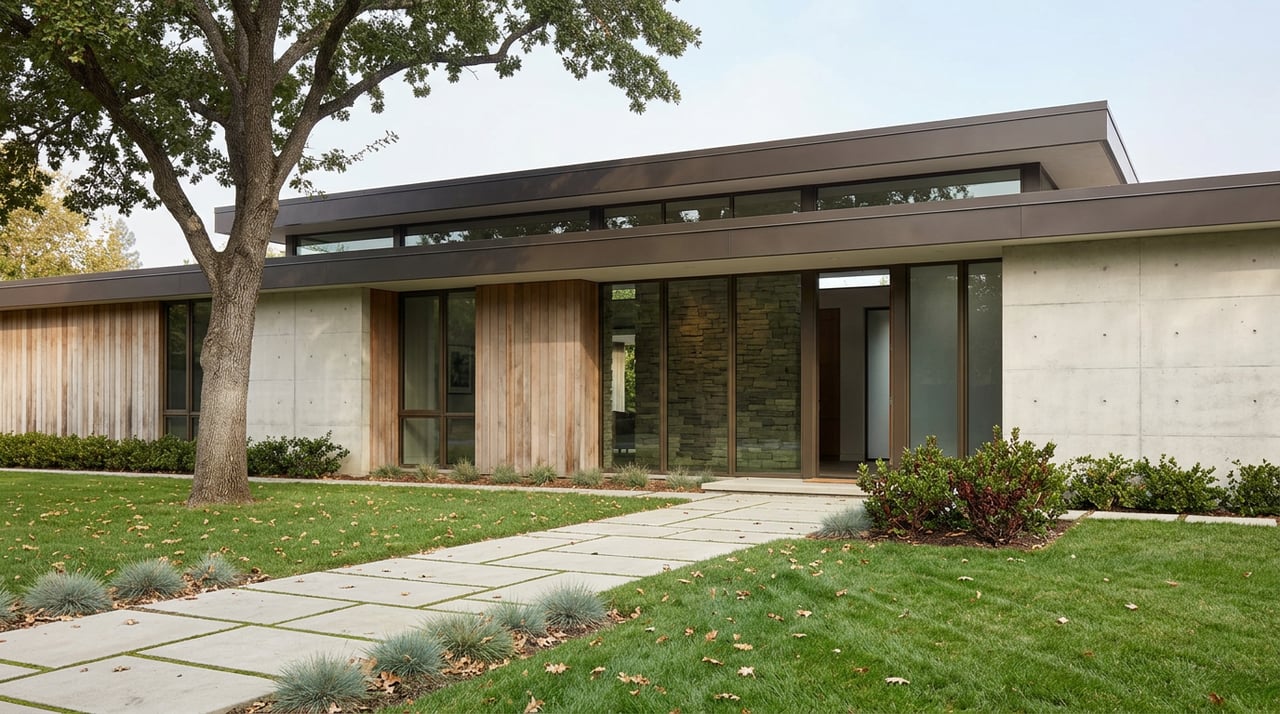
What an Atherton Acre Actually Buys: FAR, Heritage Oaks, and the SB9 Math
September 24, 2026
September 24, 2026
In January 2023, a one-story, five-bedroom house at 2 Lowery Drive became the answer to a question most Atherton buyers never think to ask until they own the parcel: how much of a 1.22-acre lot is actually yours to build on. The home, constructed in 1960 next to an elementary school, had last sold for $5.6 million in December 2021. Its owners split it under California's new SB9 law, carving out a roughly 22,000-square-foot second parcel that became 77 Edge Road. One of the developers behind the project, Palo Alto-based Mircea Voskerician, put it simply to a reporter from The Almanac.
"SB 9 opens up to more opportunities to use land in California in different ways."
The Lowery Drive split was the first one Atherton approved, and the town's own SB9 tracking page shows more have followed since. What makes the story useful to anyone shopping Atherton today isn't the split itself. It's what the split reveals about how little the acreage on a listing sheet tells you about what you can actually build, or how many houses might eventually sit on that same ground.
Atherton earned its "Atherton acre" reputation in the 1920s, when town officials set a roomy minimum lot size of just under an acre, 0.92 to be exact, and built the town's identity around it. That number still shapes how the market talks about the place. It has almost nothing to do with how big a house you can put on that lot.
Floor Area Ratio, or FAR, is the rule that actually decides the ceiling. Atherton's own FAQ page states plainly that the maximum size of a house depends on lot size and zoning district, and points anyone serious about the math to Chapters 17.32 and 17.33 of the town's zoning ordinance rather than a single headline percentage. That caution is worth taking seriously, because secondary sources describing Atherton's FAR don't agree with each other. Some planning summaries put both of the town's residential zones at an 18 percent FAR ceiling. A separate builder's guide to custom construction in Atherton describes a 0.45 ratio that can rise to 0.55 if all resident parking goes underground, which on a one-acre lot would in theory allow a home in the 20,000-square-foot range, even though most custom builds in town run 5,000 to 10,000 square feet. Smaller R-1A lots follow yet another formula entirely, with floor area calculated as lot size times 0.163 plus 726 square feet, subject to a 2,250-square-foot minimum.
The discrepancy between these figures isn't a typo somewhere. It reflects a genuinely parcel-specific system, and it's exactly why the town's FAQ tells you to go check your own zoning chapter rather than trust a rule of thumb. Before you write an offer based on what you assume you can build, confirm the actual number with Atherton planning staff for that specific address.
Setbacks do their own share of shrinking the buildable envelope, and they differ meaningfully by zone:
| Zone | Front Setback | Side Setback | Rear Setback | Height Limit | FAR (Housing Element summary) |
|---|---|---|---|---|---|
| R-1A | 60 ft | 50 ft | 60 ft | 30 ft | 18% |
| R-1B | 30 ft | 26 ft | 30 ft | 28 ft | 18% |
A 60-foot front setback and a 50-foot side setback on a large R-1A lot can eat more usable land than most buyers expect walking the property for the first time. The acreage is real. The buildable rectangle inside it is a different, smaller shape.
Before FAR and setbacks even finish the job, Atherton's Heritage Tree Ordinance can claim more of the lot. Under the town's municipal code, any oak with a trunk circumference of 48 inches or more, measured 54 inches above grade, anywhere on the property, qualifies as a protected heritage tree. Removing one requires a permit application, and if the building department doesn't find the tree dead or dangerous, the decision moves to the Planning Commission, which weighs the probability of failure, proximity to structures, and the tree's history before granting or denying removal.
Each protected tree also carries a Tree Protection Zone that limits grading, trenching, and foundation work nearby. A tree with a 20-inch diameter trunk can generate a protection radius extending more than 13 feet in every direction, according to a contractor's guide to building custom homes in the town. A cluster of oaks positioned near the center of a lot can force a home's footprint to split, shift, or shrink well before setbacks and FAR even enter the conversation. If removal does get approved, the town typically requires replacement with 48-inch box specimens and a maintenance bond equal to the appraised value of the tree, held for one to three years.
None of this shows up as a line item on a listing. It shows up during design, when an architect maps the buildable envelope against the tree survey and the client learns the real number is smaller than the acreage implied.
This is where the 2 Lowery Drive story matters beyond its headline. Atherton's own subdivision standards, separate from anything SB9 introduced, tie minimum lot size to slope: one acre for land under 20 percent slope, two acres between 20 and 35 percent, five acres beyond that. Those thresholds made splitting most Atherton lots effectively impossible under the town's traditional rules, even on parcels well over an acre.
SB9 sidesteps that entirely. The state law, which the town adopted locally as Chapter 17.53 of its municipal code, allows an owner to split a qualifying single-family lot into two parcels through ministerial review, meaning town staff process the application without a Planning Commission hearing or discretionary vote. Each resulting parcel must be at least 40 percent of the original lot's area, with a 1,200-square-foot floor, and up to two units are then allowed on each new parcel. That's the mechanism that turned a 1.22-acre lot at 2 Lowery Drive into two separately addressed properties, one of them the roughly half-acre 77 Edge Road, without ever triggering the town's own multi-acre subdivision minimums.
The tradeoff is that ministerial approval only covers the split and the objective design standards attached to it. Tree protection, access requirements, and utility service still apply, and guides written for owners considering an Atherton lot split consistently flag trees and access as the details most likely to decide whether a specific parcel actually pencils. A wooded, irregularly shaped Atherton acre can qualify for SB9 on paper and still be a poor candidate once the heritage oaks are surveyed.
As of September 2026, one property data platform puts Atherton's median single-family sale price at $9.63 million, drawn from 84 residential sales over the trailing 12 months. That number sounds settled. It isn't, and the reason matters more than the figure itself: Atherton simply doesn't generate enough transactions for a monthly or even quarterly median to behave the way it does in a normal market.
You can watch that volatility in the record from earlier this year. A separate analysis current as of April 2026 noted that Atherton had just yielded its eight-year run as the single most expensive zip code in the country to Fisher Island, Florida, and laid out the competing figures circulating at the time: a Zillow home value index near $7.89 million as of March 2026, up 9 percent year over year, against a separate March 2026 median sale price of $15.7 million built from just 12 recorded sales. With only about 16 active listings town-wide that month, the analysis pointed out that a single multimillion-dollar estate closing can swing the monthly median by seven figures. Public MLS-based reporting for the three months ending May 2026 then showed a median of $10.9 million, up 23.1 percent year over year, on 28 sales for the month.
None of these numbers are wrong. They're all describing a market where the sample size some months is smaller than a single subdivision's worth of homes. Neither the September figure nor the spring ones tell you what a specific parcel is worth once you've priced in its FAR ceiling, its tree survey, and whether it's a realistic SB9 candidate. In a market this thin, the headline median is closer to a mood than a measurement, and the parcel-level math is where the real pricing work happens.
There's a second layer of uncertainty buyers with a multi-year horizon should track. As of a subcommittee report the Atherton Town Council reviewed in mid-2025, the town was weighing whether to ask voters this November to approve charter city status, partly in response to a 2024 court ruling that favored several Southern California charter cities in a dispute over SB9. Whether charter status would actually shield Atherton from future state housing mandates remains unsettled even in the town's own analysis, and no final decision had been made as of that report. It's not a reason to delay a purchase. It's a reason to treat today's zoning rules as current, not permanent.
None of this means Atherton is a harder place to buy or sell. It means the acreage on the listing is the start of the conversation, not the answer. Before you value a lot here, or price one to sell, you want three numbers most listing sheets don't include: the confirmed FAR for that specific parcel and zone, a tree survey mapping any protection zones, and an honest read on whether the shape and slope of the lot make an SB9 split a real option or a paper one. Those three numbers, not the headline acreage and not the median price of the month, are what actually determine what the property is worth to the next owner.
Does a one-acre Atherton lot guarantee a large house? No. Floor Area Ratio, setbacks, and any heritage trees on the property can reduce the buildable footprint well below what the acreage suggests, and the town recommends confirming the exact FAR for your zone and parcel before assuming a number.
Can a heritage oak be removed to make room for construction? Only with a permit, and only if the town finds it dead, dangerous, or the Planning Commission approves removal after weighing safety and structural criteria. Approved removals typically require replacement plantings and a maintenance bond.
Does SB9 override Atherton's tree protection rules? No. SB9 removes the discretionary hearing for a qualifying lot split, but town guides consistently note that tree protection, access, and utility requirements still shape whether a specific parcel is actually feasible to split.
If you're weighing a purchase or a sale in Atherton and want the parcel-specific numbers before you commit to a price, Alexander Kalla can help you work through the zoning math with the town's current framework in hand. Let's Connect.
Stay up to date on the latest real estate trends.

A global citizen with roots in five countries, this real estate professional leverages multilingual skills to build strong relationships and advocate for clients. Expect dedication and a worldly approach. Connect today to begin your real estate journey!
Alexander Kalla | CA DRE# 02125546
16780 LARK AVE, LOS GATOS, CA 95032