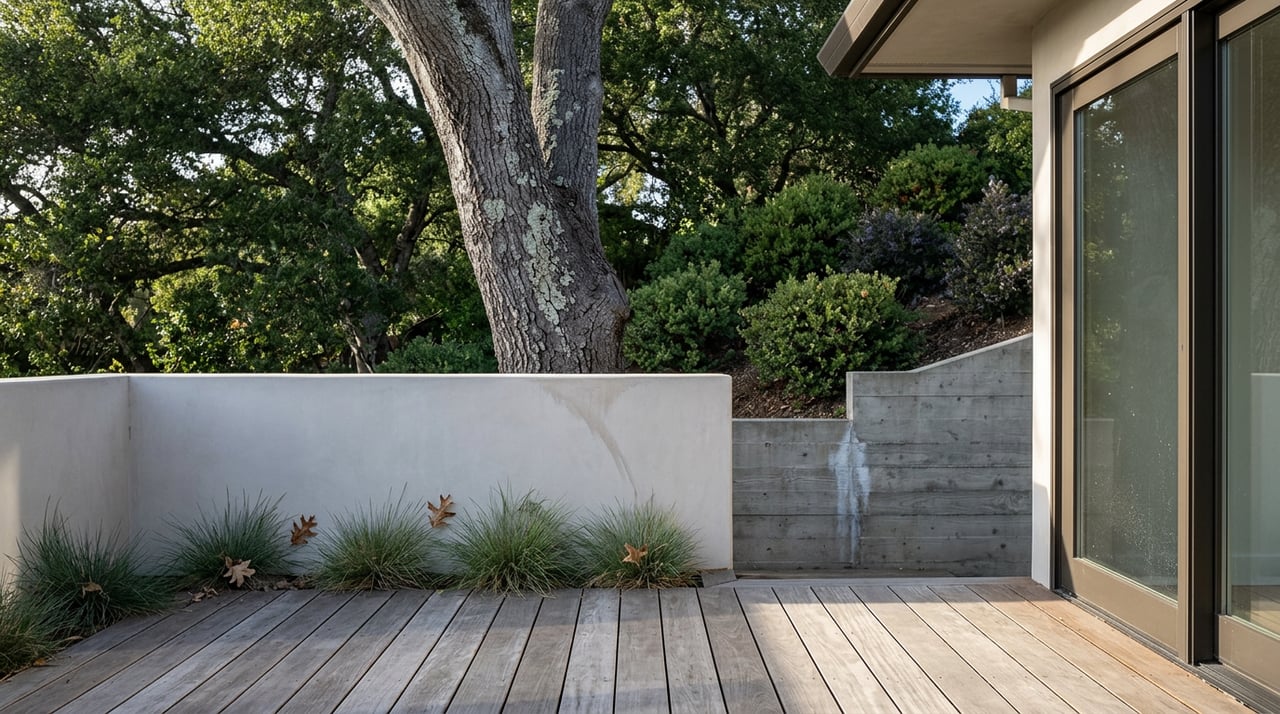
Buying a Los Gatos Hillside Home: What the Price Per Square Foot Doesn't Tell You
August 20, 2026
August 20, 2026
Open a map of Los Gatos and price per square foot drops the moment you leave the flat blocks near downtown and start climbing toward Montevina Road, Villa del Monte, or the ridges above Alta Vista. Buyers read that gap as a bargain: more house, more land, more privacy, for less money per foot. It isn't a bargain. It's a different bill, arriving on a different schedule.
The Town of Los Gatos said as much decades ago, in language still posted on its own website. Its Hillside Specific Plan states plainly that maintaining services for a hillside residence costs more than for a flatland one. What the plan doesn't say, because it's a planning document and not a buyer's guide, is which three services get more expensive, and how that shows up during escrow rather than in the listing photos.
A flatland Los Gatos home's price already has three municipal services built into it: metered water from San Jose Water Company, sanitary sewer through West Valley Sanitation District, and a road the Town owns, paves, and plows. A hillside home skips one or more of those and substitutes something a buyer has to research individually, because it doesn't get inspected, insured, or financed the same way.
| Service | Typical flatland arrangement | Common hillside arrangement |
|---|---|---|
| Water | Metered connection, San Jose Water Company | Mutual water company membership or private well/spring |
| Sewage | Public sanitary sewer, West Valley Sanitation District | On-site septic system |
| Road | Town-owned and maintained | Private road, sometimes with a recorded maintenance agreement, sometimes without one |
None of these substitutions are disqualifying. Thousands of people live well above downtown Los Gatos with all three. But the Town's own Hillside Specific Plan acknowledges that roughly four-fifths of the hillside study area was built without a paved public road, a public water utility, or a public sewer connection in the first place. That's not a fringe case. That's most of the hillside inventory.
If a hillside listing doesn't mention San Jose Water Company by name, ask who does supply the water, because in the hills the answer is often a small, member-owned utility most buyers have never encountered outside this one transaction.
Villa del Monte Mutual Water Company is a working example. It serves roughly 125 members in the Villa del Monte neighborhood and draws from two sources: water rights to Laurel Creek that have stood for more than fifty years, and a backup connection to San Jose Water Company's Montevina Treatment Plant above Lexington Reservoir, a connection built after the Loma Prieta earthquake exposed how fragile a single-source system can be. In years of light rainfall, the creek starts running dry around August, and the company leans on the purchased backup supply. That treatment plant also feeds Redwood Estates and eight other mutual water companies scattered across the Santa Cruz Mountains in two counties, which says something about how common this arrangement is in the hills above Los Gatos, not how unusual it is.
Villa del Monte isn't alone. Las Cumbres Mutual Water Company runs on an annual budget under $400,000, funded entirely by its members, to keep water moving to the Las Cumbres community. Lake Canyon Mutual Water Company serves roughly sixty hookups. On Montevina Road, the Vista Grande Water Users Association was still serving two dozen connections as of a 2011 countywide water service review. These are small operations carrying real infrastructure, run by neighbor volunteers rather than utility employees.
They also aren't permanent by default. That same countywide review noted that Redwood Mutual Water Company was purchased outright by San Jose Water Company in 2006, and that Chiri Ranch Estates Mutual Water Company dissolved into individual well connections. Membership structures change. A buyer's job isn't just to confirm which company serves a property today. It's to ask how that company is funded, whether its infrastructure has had recent capital projects like tank replacements, and whether membership transfers automatically with the deed or requires a separate application.
A public sewer connection is invisible until something goes wrong, and even then the Town, not the homeowner, usually owns the pipe. A septic system reverses that. The tank, the drainfield, and the responsibility for both sit entirely on the buyer's side of the property line.
Septic systems are typically permitted and inspected by the local health or environmental department, and that permit record is usually the fastest way to confirm a system exists and understand its design, since visual clues like a mound over the drainfield or an access riser near the outlet line aren't always obvious from a walkthrough. A general home inspection does not typically cover a septic system in depth. That's a separate inspection, with its own cost, and it belongs in the same due-diligence window as the general inspection, not after it.
The third substitution is the one buyers underestimate most, because a paved private road looks identical to a public one from the driver's seat.
California law has an answer for what happens when a shared private road has no recorded agreement: Civil Code Section 845 says that in the absence of an agreement, maintenance cost is split proportionately to each owner's use of the road. That sounds tidy until a court has to define "proportionate use." In Healy v. Onstott, a California appellate court acknowledged just how hard that is to measure literally, since two owners with different numbers of vehicles or different heating fuel deliveries don't obviously owe the same share. In Holland v. Braun, the court drew a hard line between maintenance and improvement: when some owners paved a previously dirt road on their own initiative, the court ruled that paving was an improvement, not maintenance, so Section 845 couldn't force the other owners to pay for it.
That distinction matters at the exact moment a hillside road needs its first repave in twenty years. Without a recorded agreement, there is no default answer for who pays for an upgrade, only for baseline upkeep, and even that default requires litigation to enforce if a neighbor won't pay.
This is also why a recorded Road Maintenance Agreement isn't just a nice-to-have for a hillside buyer. Private road maintenance agreements are frequently required by mortgage lenders, including Fannie Mae, FHA, and VA-backed loans, before they'll fund a purchase on a private road at all. A well-structured agreement, the kind neighboring hillside communities in the area have recorded for their own private roads, typically spells out a Road Commission Agent to collect annual dues, a reserve account for emergency repairs, and a majority-vote process for anything beyond routine upkeep. If that document doesn't exist, or hasn't been updated in years, a buyer should expect it to surface as a lender condition before closing, not as a footnote after.
None of this means the hillside is a worse buy than the flatland. Some of the largest, most private parcels in Los Gatos, the kind with mature oak canopy and panoramic ridge views, exist precisely because they sit above the reach of the Town's public infrastructure. What it means is that a lower price per square foot in the hills is not a discount so much as a transfer: less of the cost sits in the purchase price, and more of it sits in ongoing membership dues, inspection and pump-out schedules, and road reserve contributions that don't show up until someone asks.
Before comparing a hillside listing to a flatland one on price alone, it helps to ask:
Answering those five questions turns a listing's price per square foot from a number into a real comparison.
Does every hillside home in Los Gatos have septic and a private water source? No. Some hillside parcels closer to the Town's urban service boundary do connect to public water and sewer. The pattern is strongest in the more remote hillside areas, where the Town's own planning documents note that public services never reached in the first place.
Is mutual water company membership automatically transferred when I buy the home? Not always automatically. Membership structures vary by company, and some require a separate application or share transfer at closing. Ask the specific water company directly rather than assuming the deed handles it.
What happens if a hillside road has no recorded maintenance agreement? Cost-sharing defaults to California Civil Code Section 845, which splits maintenance proportionately to use, but that standard is vague enough that it has led to lawsuits over what counts as maintenance versus improvement. Lenders increasingly want a recorded agreement in place before funding.
Buying in the Los Gatos hills rewards patience and the right questions early, not after you're already in contract. Alexander Kalla works both sides of this market, downtown flatland and the hillside neighborhoods above it, and can walk you through exactly which of these three systems apply to a specific property before you write an offer. Let's Connect.
Stay up to date on the latest real estate trends.

A global citizen with roots in five countries, this real estate professional leverages multilingual skills to build strong relationships and advocate for clients. Expect dedication and a worldly approach. Connect today to begin your real estate journey!
Alexander Kalla | CA DRE# 02125546
16780 LARK AVE, LOS GATOS, CA 95032